Thursday, 19 July 2018

Indian tennis heads to a bright tomorrow, with Head Graphene 360 Speed racquets


With its leading brand ambassador Novak Djokovic winning Wimbledon, a welcome return after the 31-year-old Serb with 13 Grand Slam titles now, had spent a lot of time nursing an injured shoulder, Head is all set for launching its explosive new line of Graphene 360 Speed racquets.
With ‘’incredible stability’’ and ‘’enhanced energy’’ with a new frame ‘’engineered for speed’’, and a new string bed that provides ‘’increased power and full control at high speeds’’, the Head players are bound to turn more heads as they move towards the US Open.


Of course, Head will miss Andy Murray, who tried to make a return recently since playing his last tournament in Wimbledon last year. But, with the prodigy, the 21-year-old Alexander Zverev of Germany, the world No.3 being touted to win a Grand Slam soon, Head has a new face that has already fulfilled a lot of promise.

After the quarterfinals at the French Open, it was perhaps a big disappointment for Maria Sharapova to lose first round in Wimbledon to qualifier Vitalia Diatchenko of Belarus, but the Russian beauty continues to light up her environment even when she is not wielding a Head racquet.

Some of us do remember that Ankita Raina, the best Indian woman singles player, had given a tough account of herself in a three-setter against Diatchenko in the second qualifying round in Wimbledon. 

A bunch of girls are following on the foot prints of Ankita, in trying to march forward. Karman Kaur Thandi, who briefly snatched the No.1 status from Ankita last year, has been making meaningful strides, by winning her maiden title in the $25,000 event in Hong Kong. The 20-year-old Delhi girl sports the Head racquet with some style and purpose.


Zeel Desai who has successfully emerged out of the junior ranks, and the young National champion Mahak Jain use the Head to plough their way forward in the professional circuit.

Prarthana Thombare who had won the Asian Games bronze medal with Sania Mirza and had partnered the former world No.1 in the Rio Olympics, looks all set to have a memorable time in the Asian Games in Jakarta.

Sai Samhitha with her classic singled handed backhand, the former Asian junior champion Snehadevi Reddy, apart from the promising bunch of Humera Shaikh, Vaidehi Chaudhari, Tanisha Kashyap, Sanjana Sirimalla and Prinkle Singh are all capable of adding more visibility to Head.

The Indian fans may remember Wimbledon this time for the brilliant performance of Divij Sharan who made his maiden doubles quarterfinals with Artem Sitak of New Zealand, and the super show by qualifiers Sriram Balaji and Vishnu Vardhan, who played their maiden Grand Slam after having set Wimbledon as their target last year!


Jeevan Nedunchezhiyan and Purav Raja are the other doubles stars who are making everyone take note of their presence in the circuit.

Aryan Goveas has made rapid strides forward to be seeded No.2 in the tournament he is playing at the moment in China. Dhruv Sunish, National junior champion Sacchitt Sharma, Abhimanyu Vannem Reddy, Calvin Golmei, Dev Javia, Sushant Dabas, Ajay Malik and Udit Gogoi have the ability to step it up in the next few months, provided they channelise their Head!

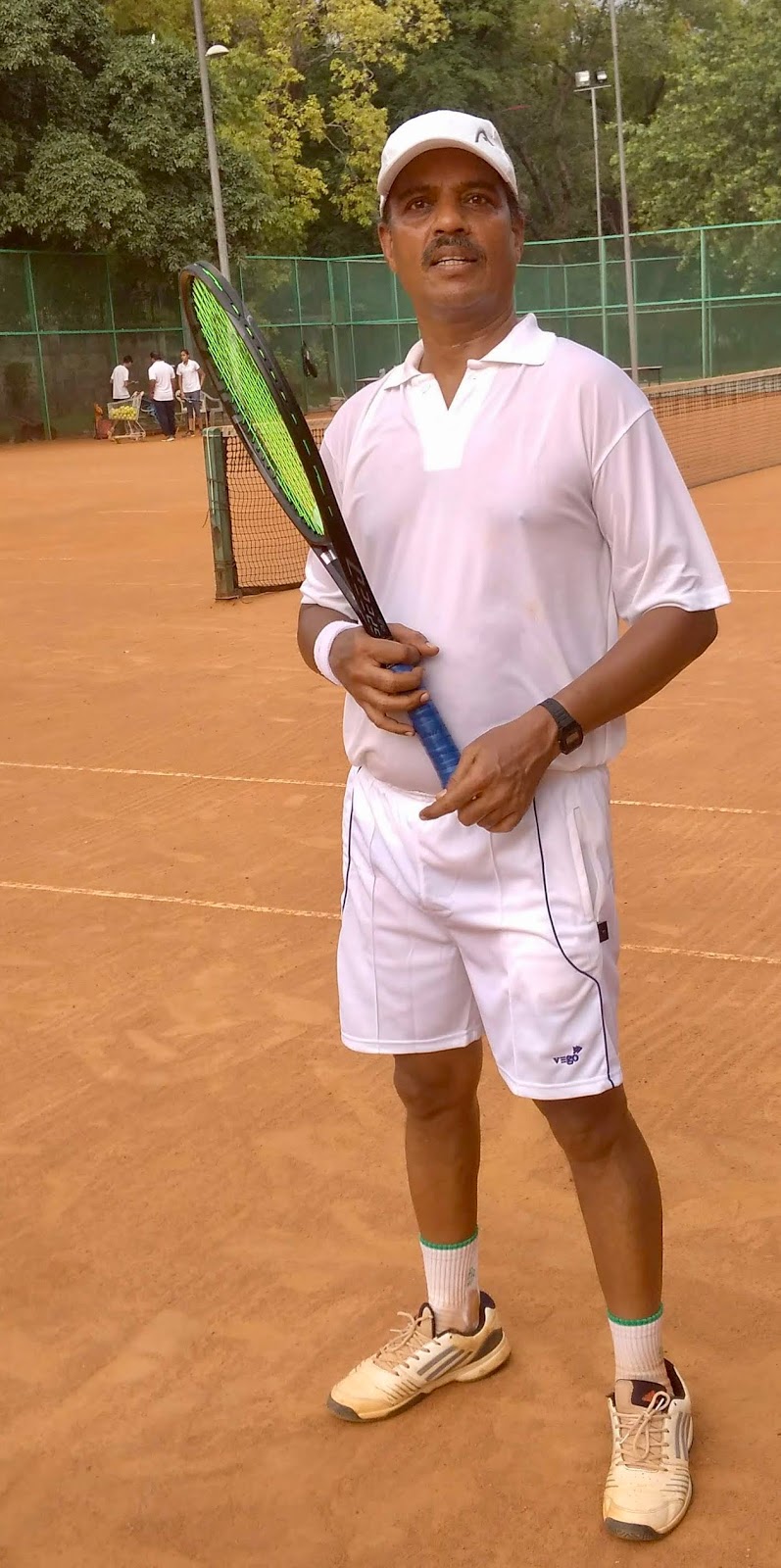
For an amateur player like me who likes to keep fit and appreciate the nuances of the game better by playing on the clay courts of the National Stadium in Delhi, it is a privilege to swing the Graphene 360 Speed MP racquet, to add some substance to the enjoyable game.


It may be cool to sport the latest Head, but it is great to sweat, to keep your head cool.

It is always a good time to head to the tennis courts !

Wednesday, 28 February 2018

Ankita Raina would love to thank Somdev Devvarman from the bottom of her heart!


Whenever she writes a book, looking at her career, Ankita Raina will profusely thank Somdev Devvarman, for providing the impetus at a crucial juncture !


More than all her supporters, Somdev has done a good turn to Ankita, first by excluding her from the Target Olympic Podium Scheme (TOPS) list and then by justifying his wisdom.

For sure, it is heart breaking at the moment for the girl, easily the best Indian woman tennis player, to be excluded from an elite list, not just because she loses Rs.50,000 pocket money every month.

To say that she is not good enough to compete in the next Olympics in Tokyo is too harsh a statement. Well, did Sunitha Rao, Rushmi Chakravarthi and Prarthana Thombare, believe that they would compete in the Beijing, London and Rio Olympics?! They did, thanks to the ability of Sania Mirza to lift Indian women’s tennis to a different sphere.

For sure, Ankita Raina has been unlucky to miss the Rio Olympics, as she did not fit into the scheme of things. So be it. But, that has only helped her focus on her game and fitness with all the intensity and earnestness that she could gather.

Now, Somdev has jumped into the fray to whip the best game out of her, like they churn out butter from curd !

It is better for Ankita, but it is harsh on her.

No Indian woman tennis player has played the quality of tennis that Ankita played during the recent FedCup in Delhi, after having hinted at a jump in quality and fitness with a fabulous performance in the quarterfinals of the $125,000 WTA event in Mumbai.

To top it all, Ankita played a 4-6, 4-6 match against the former world No.4 Samantha Stosur of Australia in Dubai. With a bit of luck and perseverance, she will be winning such matches and jumping up the rankings ladder.

Now, let us not question Somdev as to how much women’s tennis he has ever watched, or whether he has watched Ankita Raina play a match.

Well, to take the argument further, did Somdev ever dream about competing in the London Olympics?!

Lest anyone jump to a wrong conclusion, we make it very clear that nobody is questioning his achievements. He did win NCAA singles title twice in the highly competitive American collegiate circuit, beating no less than a player than the towering John Isner. He did win the Commonwealth Games gold apart from the singles and doubles gold in the Asian Games in Guangzhou in 2010. He has played some impressive matches in the Davis Cup against top quality players.

Somdev had reached a career-best rank of No.62 in 2011, the best by an Indian after Ramesh Krishnan. Better than No.73 that Leander Paes reached in 1998, after having won the singles bronze medal in Atlanta in 1996.

If the same yard stick had been used, Leander had no business winning that Olympic medal, when he was not even ranked in the top-100 of the world. In fact, he had only played in three first round matches in the Grand Slams.

Coming back to the point, from November 2011, Somdev did not play a single match on the professional circuit, owing to injury, before he competed in the London Olympics on a wild card on the grass courts of Wimbledon, and won four games against Jarko Nieminen of Finland. 

The AITA managed to get a wild card for a wounded horse, when some of us thought that the young Yuki Bhambri who had won the Australian Open juniors, was world No.1 junior,  and had finished runner-up in the Youth Olympics could gain from the experience of playing the Olympics.

Stretching the argument further, we also see that Vishnu Vardhan not only played the doubles with Leander Paes, so superbly at that, but also played the singles as an alternate in the London Olympics. Did anyone say before hand that Vishnu was Olympics material.

The point is, we cannot dismiss the chance of a player to compete in the Olympics, especially someone like Ankita Raina who has been No.1 in the country for many years. If the others are not able to overtake her, how do they convince anyone that they would play better than Ankita on the big stage.

It is a tough game, and it is unfair to look at the age of a player_and Ankita is only 25_or a perceived stagnation of rank, to keep a player out, especially when the whole country is jumping into the bandwagon and reaping the rewards in terms of support.

In a strange situation, it is a player against a player, while the permanent villain in all sports discussion, like the National federation, has recommended Ankita’s name to the Union government to correct the anomaly.

Rather than finding fault with Somdev’s assessment, the authorities should have a woman athlete as the government observer for women in each game. It will be the right thing to do, at a time when the 2020 Tokyo Olympics is aiming at gender equality.

Someone like Nirupama Sanjeev, a pioneer in women’s tennis before Sania Mirza broke into stage with such flair and firepower, must be bleeding in her heart to see the gross injustice being meted out to Ankita.

Being brave, Ankita would attempt to make the best of a bad bargain, and continue to strive hard to get better, with a lot more determination.

But, any system that keeps the best out, beats itself.

Ankita’s non-inclusion in the TOPS is blatant injustice to one of the best athletes we have seen.

Monday, 1 May 2017

Our champions are flawed genius, we need to respect their pride

When Mahesh Bhupathi won the National men’s title on grass in Chandigarh in 1994, the first question one fielded on return to the Capital was whether the young champion could beat Leander Paes !

More than two decades later, the question continues to persist, ‘’Can Mahesh beat Leander’’.

To put the record straight, Mahesh has not beaten Leander in singles in the professional circuit. He has beaten him otherwise. Leander beat him thrice in singles, and two of them were in Challenger finals.

The only time Mahesh did get past Leander in a professional draw, was when he got a walkover from the top seed in the semifinals of the Jakarta Challenger in 1994. Mahesh as a qualifier went on to win the title, his only Challenger singles title.

This was immediately after Mahesh had got into the Davis Cup team for the tie against South Africa in Jaipur, even though he was not played then. He had done well in two Satellite circuits in Malaysia and Indonesia to gain the attention of the national selectors.

Despite the fact that he had won the Challenger and made the doubles final with Leander, Mahesh made it a point to play the National championship to assert his stature and standard.

Lest the young readers jump into any conclusion, one hastens to stress that Mahesh was a superb singles player as he showed many times in the Grand Slams, ATP events and Davis Cup.

However, as CGK Bhupathi said the day after Mahesh had won the national singles title in 1994, he was tipped to be a top-10 doubles player. It was some conviction of the dad of a 20-year-old Mahesh to say that he would question his knowledge as a coach if his son did not become a top-10 doubles player.

For sure, Mahesh had a big serve, a huge backhand and a menacing forehand. But, Leander had the legs and the tenacity to outwit him. And the ability to charm the media! This was one difficult part to digest. 

It is another matter that the problem persists despite the media for the majority being disillusioned with Leander and his perennial plea for justice.

Mahesh’s partnership with Leander, the contrasting style of play of the two along with their intrinsic understanding, made them a world class pair, the best in the world, who could take on the Woodies, Mark Woodforde and Todd Woodbridge apart from the Dutchmen, Jacco Eltingh and Paul Haarhuis.

Mahesh did not drop serve in tournaments, at times week after week, because Leander was at the net. It was a lethal combination.

Over the years, Mahesh had always looked up to Leander, even though the latter would tease him endlessly, especially through the media interactions, questioning his fitness time and again. And possibly the lack of gratitude for getting his international career launched in such style, without much investment!

It was nearly impossible to tackle the guile of Leander. Mahesh, who speaks his heart straight, had exploded at times, unable to sustain his silence, like when he said that he had played his last match with Leander after winning the doubles gold in the turbulent Doha Asian Games in 2006. For sure, the two played together thereafter in the Beijing Olympics and on the circuit as well, not to forget Davis Cup.

Even as he got the best out of his partners on court, Leander got their bad side out, off the court, leading to considerable friction. It had something to do with Leander’s personality. He was the king of everything he surveyed. Without that attitude, he could not have won that Atlanta Olympics singles bronze medal in 1996.

However, it was not just Mahesh but a bunch of players who were unable to digest the methods of Leander over the years, but could never pin him down. Thus, it was only natural that Mahesh was viewed as the leader who can win them justice, at some stage.

Hence, it was no surprise that Mahesh was convinced to play Rohan Bopanna in the tie against the Uzbeks in Bengaluru. For sure, he had not made up his mind to insult Leander, as many would like us to believe.

As the new captain, who did not have two best singles players Yuki Bhambri and Saketh Myneni in the team, Mahesh was understandably reluctant to drop his best doubles player, his trusted partner with whom he had competed in the London Olympics. There was no question of Mahesh saying ‘’No’’ to Leander from flying into Bengaluru from Mexico, for he was still toying with the choice.

It was a tricky situation, and as the captain Mahesh was a bit jittery, trying to rely on Ramkumar Ramanathan and the inexperienced Prajnesh Gunneswaran for singles, even though Uzbekistan without Denis Istomin was like a snake without venom.

It was equally understandable that Leander exploded to the media, unable to hide his anguish. Being the aggrieved, not so much experienced at that, Leander deserved to express himself, and question Mahesh. It is difficult for the captain to extend the gag order to a reserve player, and someone of the stature of Leander.

To expect Leander to stay for the whole tie was unreasonable, and to say that it was ‘’the last nail in the coffin’’ was another expression of Mahesh that would haunt him.

Mahesh as the captain had every right to choose his team and he had made it clear at every stage, and had been very polite and considerate to Leander. He did not have to prove it to the world, by releasing the text messages.

But, if you have a young captain who had played the circuit only last year, you do not expect the maturity of a Naresh Kumar or a Ramesh Krishnan.

The good thing is that Leander has been stung badly. As a player he is quite content with what he has achieved with his limited game! He has played in seven successive Olympics that no tennis player has ever done. It is also the highest by an Indian sportsman. His Davis Cup record is imposing. In fact, for all the talks that he is playing for the record, Leander does have the record for the highest number of doubles wins in Davis Cup.

For one having shared so many records with Mahesh, with whom he has such a strong love, hate relationship, Leander does not mind sharing a record with Nicola Pietrangeli of Italy, who incidentally has the singles record as well for maximum number of wins in Davis Cup.

In such a back drop, one should admire the hunger of Leander to compete in the small Challengers to stay alive in the circuit, even though it means considerable loss of money. He has to endure so much after being used to the big league for so long. But, the last thing a champion like Leander would want is anyone’s sympathy.

Without their pride, the champions are nothing. It is something we often forget.

For all his services, and the way he has been getting the results, Leander feels that he deserves to walk into the team as a matter of right. It is unfair to remind someone of the numbers in the ranking game, for, all his life Leander has been defying the numbers.

As a knowledgeable friend pointed out the other day, Leander possibly got it wrong when he called Vishnu Vardhan on the eve of the draw for the tie against New Zealand in Pune, when Saketh Myneni pulled out. He would have got that elusive doubles win in the company of Yuki Bhambri. The Kiwis were no team, even though they had a good doubles combination.

The Uzbeks, in comparison, were tough in singles, at least on paper.

For all the bitter words that have been spoken over time, it will be a miracle if Leander and Bopanna pair up for any match.

Yet, the best of human calculations can go wrong when time plays its cards!

Even as Bopanna has consolidated his position, by winning the ATP Masters title in Monte Carlo, Leander is fighting hard in the Challengers, winning two of them in Leon and Tallahassee. There are still three more Grand Slams, the French Open, Wimbledon and the US Open, before India plays its World Group play-off Davis Cup tie against Canada in Canada.

If any of us is busy writing the last lines for the brilliant career of Leander Paes, we will be exposing our ignorance about the superman of Indian sports.

In a long conversation in Rio de Janeiro, after the early exit in doubles in the Olympics, Leander agreed to one point with a twinkle in his eye. It was a simple observation.
All our champions have flaws. If you remove the flaws, the whole structure could collapse. The flaws make them, as much as their better qualities !

We are all human and none of us is perfect. As successful people, the champions naturally believe that their perception is absolute right.

As fans who enjoy all their achievements and feel proud about them, we need to educate ourselves to accept the flaws in our champions, be it Mahesh or Leander.

It is impolite to ask them to behave !

Saturday, 8 April 2017

The much maligned Mahesh Bhupathi spoils his image further on captaincy debut

For most of us, Mahesh Bhupathi may be the villain, donning the captain’s hat, and putting an end to the career of Leander Paes, at least in Davis Cup.
For some of us, Mahesh Bhupathi is a captain with a vision, who will ensure that the brilliant career of Leander Paes has a bright and worthy finish.
Against a weak Uzbekistan team, struggling without its spearhead Denis Istomin, it would have been the easiest thing to field Paes, with or without Rohan Bopanna, and ensure that the champion gets the record for maximum doubles wins of 43 in Davis Cup.
For all the inspiration that he manages to eke out from nowhere, and the enthusiasm that has seen him compete in seven straight Olympics, the 43-year-old Paes may have been tempted to say goodbye to the Davis Cup theatre.
There was nothing much left to prove for him, or so most of us had thought.
To fly from Mexico across the globe to Bengaluru, despite being named only as a reserve, Paes had done everything within his reach to be eligible for inclusion in the tie. Even though the knowledgeable CGK Bhupathi chose to term a $75,000 Challenger as a ‘’two bit’’ event, and chose to dismiss Paes winning it, as some sort of bad preparation, merely because of the anguish at the attack launched against his son, it was clear that Paes had stretched himself quite a bit to be ready.
All the arguments of Paes are absolutely fair, when he cried foul on not being nominated in the four-member team for the tie. They are almost on similar lines to the argument that Bopanna put forth, when he was dropped for the tie against New Zealand.
However, Paes had agreed that the captain had the prerogative to choose his team. He wanted a phone call, intimating him that he was not wanted.
That was not possible. It would have been suicidal to say ‘’no’’ to a reserve player, especially after what had happened in the previous tie against New Zealand in Pune. Vishnu Vardhan had to fly from Hyderabad on the morning of the draw, and understandably was not as sharp as he could have been, as he and Paes, the London Olympics partners, lost in four sets.
So, there was no question of telling Paes that he was not wanted in advance. But the fact remained that Mahesh never kept Paes in his four-member team. He would have kept him out of the six member squad had the national selectors and the All India Tennis Association (AITA) listened to his line of thought.
Mahesh firmly believes in the ‘’horses for courses’’ policy. He chose Bengaluru because it would suit the big servers and the fast court would suit the stroke players. It was impossible to keep Bopanna out in such a scenario.
The idea was not to get rid of Paes, by helping him to the record, but to ensure that he plays his part when required. No captain would have been able to convince someone like Paes, with such a rich Davis Cup record, to sit out. It was no wonder that Mahesh failed, even though there is no doubt that he is the biggest fan of Paes.
If we brush up our memory, not long ago, Mahesh had kept Paes in the International Premier Tennis League (IPTL), his personal baby. So, where is the question of not wanting Paes in the Davis Cup squad.
To be fair to him, Mahesh also wants to break the mould, and create a new structure for Indian team. There has been enough of doubles. Let us not forget that Paes himself was so heroic in so many singles matches, against some of the best players in the world, rather than doubles, in the Davis Cup theatre.
Had Yuki Bhambri been fit and playing, Mahesh could have even kept his friend Bopanna out, to try and make the singles specialists ready for hard battle. For sure, Mahesh does not require Davis Cup to prove anything to Bopanna, or settle scores against Paes. The much maligned Mahesh certainly has some vision for Indian tennis.
In fact, Mahesh did have a chat with Paes in Dubai during the ATP event recently and had expressed that it was a privilege to captain a team with him. In the same breath, Mahesh had also made it clear that nobody was guaranteed a place.
The only request from Paes was that he should not be kept in the squad, if he was not being played. It was a gentleman’s promise, but it was not in Mahesh’s hands to keep Paes out of the squad for the tie against Uzbekistan !
Obviously, Paes needs a high quality partner, whom he could trust, to bring his best game out. With due respect to all the players, not many in Indian tennis can inspire that. Saketh Myneni and Paes played a brilliant match against the Olympic champions Rafael Nadal and Marc Lopez in Delhi last September in the World Group play-off, but fell short at the crunch.
Paes and Bopanna had fared miserably against the Czech in the Capital two years ago, after the same pair had bounced back from being down two sets and a break, to beat the Serbs in Bengaluru, in 2014. Paes and Bopanna had won against easy meat, the Koreans, on grass in Chandigarh last year before all the bitterness came to the top in the run-up to the Rio Olympics and the climax in Brazil, when Paes and Bopanna crashed out in the first round.
Ever since Bopanna announced that he could not strike a winning partnership with Paes, and wanted to play with Saketh instead, at the Rio Olympics, by virtue of being a top-10 player with the right to choose his partner, Paes must have been convinced that there was a group in operation to keep him out.
In such a back drop, Paes was literally challenging everyone to drop him. In the process, he walked into a punch that shook his senses.
‘’Sometimes, you have to take things on the chin, throw your shoulders back and keep working hard’’, Paes had said.
The complaint and moaning apart, his positive mind set, after being dropped, clearly indicate that we still have a lot to see of Paes. So, let nobody be in any hurry to write the end game for him.
He may not like to read these lines, but this was the bitter tonic that Paes needed to fire himself up, on possibly the final stretch of his professional tennis career. Champions are best known when they face adversity. In his distinguished career, Paes has jumped over many hurdles to establish his ability to go, far beyond his limitations.
No matter how much people criticise Paes for not being diligent with his training schedules, or find fault, even if it is rain that stops training after three games, there is no doubt that whenever he wants, Paes can put the flesh and spirit in sync, dancing to his tune. He is still the quickest at the net on planet earth. If he gets the right partner, Paes can win Grand Slam doubles, not just mixed doubles with Martina Hingis, the incomparable Swiss miss.
All he needs is the motivation. Mahesh Bhupathi and the tricky situation has given him plenty of it!
It is unfair to call someone a villain, when he brings out the best in a champion like Paes.
For all the sickness that people feel on looking at Indian tennis, they just need to detach themselves and look at the big picture.
For sure, it is getting better. For all his 27 years and many years of tennis around the world, few knew Prajnesh Gunneswaran, the left-hander from Chennai, who fired the bombs on the opening day of Davis Cup against the Uzbeks and hit with such a flourish and intensity.
The players may be the same, but Indian tennis is a kaleidoscope, ready to project many fascinating and colourful pictures.

Fortunately or unfortunately, nothing will be in black and white !

Saturday, 12 March 2016

Sanjeev Rajput, a soft target ?!

NRAI president Raninder Singh congratulates Sanjeev Rajput


It is March, and most of the athletes are gunning for their Olympic berths. Many others have to wait for the ranking lists, weeks before the Olympics, to ensure their entry for the quadrennial extravaganza.

In shooting, however, the Olympic berths are about to be assigned to the shooters as a final confirmation of their entry for the Rio Olympics, by the national federation.

India has won 12 Olympic quota places, one more than last time. For the overall development of the sport in the last four years in the country, the added number is no indication and only a poor reflection, as many quota places agonisingly eluded the grasp of our shooters.

Abhinav Bindra, Gagan Narang, Chain Singh, Sanjeev Rajput, Apurvi Chandela, Ayonika Paul in rifle, Heena Sidhu, Gurpreet Singh, Jitu Rai, Prakash Nanjappa in pistol and Kynan Chenai and Mairaj Ahmad Khan in shotgun have won the Olympic quota places.

China (23), Russia (20), US (20), Australia (18), Germany 16),Italy (14), Egypt (12), France (11), Serbia (9) are the other leading countries in terms of the number of quota places won in shooting. Only 390 shooters make it to the Olympics to win the 45 medals spread over 15 events in pistol, rifle and shotgun.

With the Olympic quota places belonging to the country and not to the athletes who have won it, the national federation has the authority to field the shooters of its choice, with a maximum of two per event.

While most of the berths are likely to be taken by the athletes who have won the quota, there are some slots that may find replacements, breaking the heart of the shooters who won the quota.
Former World Champion Manavjit Singh Sandhu, a three-time Olympian, is already understood to have put himself in the No.1 spot in the national averages in men's trap, so as to take the flight to Rio on the Olympic quota won by the young Kynan Chenai.

Gurpreet Singh, the rapid fire pistol specialist who has won the Olympic quota in air pistol, may not be in the top-2 in the event in the averages, but is tipped to shoot air pistol along with Jitu Rai, ahead of Prakash Nanjappa who has won an air pistol bronze in the World Cup in 2013, and had placed ninth in the World Championship in Granada in 2014.

Prakash will be shooting the free pistol with Jitu Rai, the World Championship silver medallist, the Asian Games gold medallist who recently won the World Cup gold in the event in Bangkok.
Sanjeev Rajput, Gagan Narang

The National Rifle Association of India (NRAI) has projected in the media recently that shooters who have not won the Olympic quota place, like Olympic silver medallist Vijay Kumar and the young rifle shooter Elizabeth Susan Koshy, also stood a chance to make it to the Rio Games.

A country can request for a maximum of one Olympic quota place in an event, to be replaced by one in another event, from the ISSF.

The soft target, carefully presented by the national federation, is that of Sanjeev Rajput, who won the Olympic quota in men’s rifle 3-position event in the Asia Olympic qualification competition at the Dr. Karni Singh Range in Delhi.

In fact, Sanjeev was literally winning the Olympic quota for the second time, as he had also done well in the Asian Championship in Kuwait, from which the 35 Olympic quota places were revoked by the International Olympic Committee (IOC).

It is important to note that seven shooters who competed in the London Games, Vijay Kumar, Ronjan Sodhi, Manavjit Singh Sandhu, Rahi Sarnobat, Annu Raj Singh, Shagun Chowdhary and Joydeep Karmakar could not win the Olympic quota for Rio.

If he is allowed, Sanjeev will be shooting his third Olympics. Experience counts for everything on a global stage like the Olympics. Except for Rajyavardhan Singh Rathore in Athens and Vijay Kumar in London who won Olympic silver on their first attempt, the Olympic medals for India have been achieved by Abhinav Bindra and Gagan Narang in their third Olympics.

The standard argument is that Gagan Narang, the World Championship and Olympic bronze medallist in air rifle, would shoot all three rifle events. It will not be prudent to question the ability of the much-decorated Gagan, but it does not require much wisdom to say that a shooter focused in fewer event stands a better chance to strike a medal.

Sanjeev had won the World Cup gold in the rifle 3-position event, with a national record score of 1176. Despite the consistency of Chain Singh and Gagan Narang, that record is yet to be disturbed. There is no reason why Sanjeev who is settling into the event, with his new equipment, will not be able to strike such form in Rio.

Of course, Gagan had also won a World Cup gold in rifle 3P in Changwonn in 2009, following a qualification score of 1166, and the Doha Asian Games bronze medal in 2006 with a score of 1162.

After shooting only air rifle in Athens, Gagan had placed 13th (1167) and 20th (1164) in the 3P event in the Beijing and London Games. He was 35th (589) and 18th (593) in the prone event in the Beijing and London Olympics.

In the last two World Championships also, Gagan was 13th (1171) and 32nd (1166) in 3P and 62nd (591) and sixth (625.5) in the prone event. It may also be noted that Gagan when he shot only air rifle, had set two world records in winning the World Cup Final gold in air rifle in 2008.

Now that he has qualified in prone and has been slowly recapturing his best in his main event air rifle, it will be a good idea for Gagan to concentrate on these two, so as to strike more medals in Olympics. The men’s rifle events are scheduled for August 8 (air), 12 (prone) and 14 (3P). Some times, one needs to give up something to get something.

As beautifully expressed during the opening ceremony of the Asia Olympic Qualification Competition, even the Sun’s rays burn only when brought into a focus, and not when they are scattered !

The national federation often fires its salvos conveniently placing its gun on the shoulders of the shooters. Thus, Prakash Nanjappa is asked whether he would like to forego his air pistol spot, or Gagan Narang is asked whether he would like to give up rifle 3-position event. The response can be different.

Quite ironically, rather than keeping everyone ready, the national federation fielded only 12 shooters in the first World Cup of the season in Bangkok. There was no Vijay Kumar or Elizabeth Susan Koshy, not to mention the numerous other leading shooters. The focus was purely on the shooters who had won the Olympic quota places. The rest were shooting national selection trials in Kerala.

It is important to encourage shooters to win the Olympic quota places. The best way is to help them compete in the Olympics unless there is a dramatic dip in form, as in the case of Hariom Singh. After figuring in the final of the World Championship, Hariom lost his place in the national team and eventually the Olympic quota place to Joydeep Karmakar, who eventually placed fourth in men’s rifle prone event in the London Olympics.

Imran Hasan Khan’s Olympic quota in rifle 3-position event was exchanged for a pistol quota for Heena Sidhu for the London Games. That quota had been won with a poor score of 1139, and deserved to be replaced.

In contrast, Sanjeev Rajput is as good a rifle 3-position shooter as India has ever had, and richly deserves to be given a chance to win an Olympic medal. With the rule of zero-start in the finals, you never know what medal anyone could win !

Moreover, it may be recalled that the national federation had toyed with the idea of replacing World Champion Abhinav Bindra with the Asian champion PT Raghunath for the Beijing Olympics. Better sense prevailed, and history was made.

Hopefully, it will be fair play once again for someone like Sanjeev Rajput who has quit the Navy and has been spending all his resources on his shooting. He has the excellence, experience and the hunger to succeed, if given a chance.

Indian shooting is so rich that there are at least a dozen shooters who have been either very close to winning the Olympic quota place or deserve a look. But, it is very important to reward the ones who have won it, if only to make sure that shooters would attack the Olympic quota places with all their strength in future, convinced that it would help them go to the Olympics.

Sometimes, it pays to keep things simple, rather than exercise authority.

Sunday, 6 December 2015

Will there be a radical change of fortunes for Indian tennis !


There is no end or start to the season in Indian tennis. The players are constantly travelling to make points and boost their career. Sometimes, it pays to stay busy by the end of the season when the top professional s are training for the next season !

A bunch of Indian players, both men and women, will be looking forward to having a ‘’radical’’ change to their fortunes, thanks to Graphene XT Technology introduced recently by Head, one of the leading tennis equipment manufacturer based in Austria.

Of course, someone like Leander Paes who had shifted to Head sometime back, would attempt to continue with the winning ways as he had won three Grand Slam mixed doubles titles with Martina Hingis this season. His focus would be to keep his men’s doubles ranking up with a good run towards the Rio Olympics, which would be his seventh Olympics on the trot, a record for any sportsman, especially a tennis player.

While Andy Murray, the leading face of Head, promoting the brand around the world, would attempt to add more Grand Slam titles and possibly defend his Olympic gold won at Wimbledon during the London Games, the less renowned Indian tennis players, including Vishnu Vardhan, who had such a memorable London Olympics would attempt to ride on technology as much as their will to succeed.
Sriram Balaji, VM Ranjeet, Mohit Mayur, Sidharth Rawat, Kaza Vinayak Sharma, Anvit Bendre, Suraj Pabodh, Ronit Singh Bisht, Shaikh Abdulllah, PC Vignesh and Prajwal Dev are some of the Indian players who use Head or supported by it.

Already Ronit Bisht has made an impact by making the final of the ITF men’s Futures event in Jassowal, Ludhiana. Sriram Balaji, recovering from illness will be looking to get back to the winning ways that had seen him reach a career best rank of 309 around the same time last year. He is a bit confused about his training stint at the Schuettler Waske Tennis-University in Germany, scheduled after the Chennai Open, coinciding with a series of tournaments in Asia.

For sure, Balaji is a Challenger class player, and needs to get back to that level soon. It is a pity that some Challengers would be missing from the Indian calendar in the early part of next season. Noticeably, the Delhi Open $100,000 Challenger would offer half the prize money this time.

Among the Indian women, Karman Kaur Thandi is the brightest prospect, wielding the Head. If she can play her best, using her height, reach and the big serves to good effect, she may be able to jump up in the ranking list from her modest current status of being 776 in the world.

Rishika Sunkara, Snehadevi Reddy, Sowjanya Bavissetti, Sri Vaishnavi Peddi Reddy, Sai Samhitha, Shweta Rana, Asha Nandakumar, Akshara Iska, Vasavi Ganesan, Sneha Padamata, Himani Mor, Preethi Ujjini and Moulika Ram are the other Indian women players using their Head to prosper on a tennis court, with varying degree of success!

The Radical collection, promises to offer a broad range of choice to match all of the tennis equipment, head to toe! Basically, the Graphene XT technology makes room for better distribution of weight from the shaft to the tip and grip, resulting in more power and an improved energy transfer for a faster game.

From among the four models, Pro, MPA, S and LITE, the MPA model has an adaptive string pattern (ASP). It allows the players to decide between a 16/16 and a 16/19 string pattern for spin adaptability!

The distinct message is, the future is here and it is Radical!


Interesting times ahead for the tennis players and enthusiasts.

Wednesday, 26 August 2015

Dr. Karni Singh, media and the shooting range

''For my good friend Mr. Sriman, with a million thanks for what you and the Times of India did for clay pigeon''. --- Karni Singh, Asiad 1982.

Dr. Karni Singh of Bikaner, and the great R. Sriman, the Sports Editor of Times of India, have left behind a rich legacy.

The World Championship silver medallist in trap in Cairo in 1962, Karni Singh wrote that nice note in his book, ''From Rome to Moscow, the memoirs of an Olympic trap shooter'', while presenting it to Sriman.

For some of us who feel proud to have done our bit for the sport, it is a humbling presentation.
In his preface, Karni Singh thanks a whole lot of people in the media, at a time when the Indian media had not exploded into this big a form as we find it today.

''I would also like to take this opportunity to convey my appreciation to all those very fine men of the sports pages of Indian newspapers, as also the All India Radio and T.V., who helped to build up the Clay Pigeon sport in our country, and but for whose help Clay Pigeon shooting would have remained unknown. I would like to mention names of kind friends who as sports editors of our major newspapers and magazines, helped to encourage this sport. Noteworthy amongst them are Mr. R. Sriman, Mr. Prabhu, the late Mr. Jadav, Mr. Bikram Singh, Mr. Daniels, Mr. Ron Hendricks, Mr. Wadhwani, Mr. Vernon Ram and Mr. Vijay Kaura amongst many others who showed special interest in this sport. The author expresses his appreciation to Mr. Melville de Mello, Mr. Surjit Sen, Mr. Jasdev Singh, Mr. Laxman Tandan and Mr. Sanyal of All India Radio who were also responsible to catapult this sport to its present position by educating the people through Radio and TV in our country''.

Continuing further with his appreciation of the Indian media, Karni Singh praises the sports magazines for their contribution.

''India's sports magazines deserve special thanks for the wide coverage given to Clay Pigeon shooting and the prominent amongst them are Sports and Pastime, Sports Week, Sports World and the famous Illustrated Weekly of India, and Dharmayug (Hindi). The author wishes to express his appreciation to the editors of these famous magazines, prominent amongst whom are Mr. Khalid Ansari, Mr. Sharad Kotnis, the Nawab of Pataudi and Mr. Raju Bharatan for the encouragement given by them to this sport''.

It is indeed a privilege to have the book presented to Sriman, thanks mainly to his daughter Radhica and my colleague in The Hindu, Vijay Lokapally. Of course, it was a morale-booster to be told by Sriman, way back in 1990, during a football tournament at the Ambedkar Stadium that one had a brilliant career ahead! It was an education listening to Sriman, even though everyone feared his acerbic tongue. He could praise and curse with equal felicity.

While he was sparse with his praise, few could tolerate the sting of his tongue.

Even Sriman would have sympathised at the plight of the sports journalists today, and sought the ears of the administrator for special treatment. Never mind the fact that Sriman had maintained that the profession had gone to the dogs because dogs had come into the profession !

For, it has become a gigantic task just to gain entry into the Dr. Karni Singh Shooting Range in Tughlakabad, if you are a person from the media.

My friend Vinayak Padmadeo of the Hindustan Times had to wait nearly for 40 minutes outside the gates on Wednesday, the first day of Olympic trials, before he was allowed inside. I had to wait a few minutes. But four security guards came to us at the 10-metre range while we were watching the Olympic trials, featuring the cream of Indian talent.

They were apologetic and said that we had no permission to be in the premises.
Frantic calls to the National Rifle Association of India (NRAI) and the Sports Authority of India (SAI) did not lead to a solution as the Administrator of the shooting range was not willing to take phone calls. Eventually, we had to leave the shooting and reach the administrator who offered tea and said that he was not informed about the individual media persons.

Digvijay Singh Deo, the Sports Editor of CNN-IBN had taken permission to conduct interviews at the range. It was understandable. The print journalists merely made entries on the register at the gate, which has been a common practice for everyone.

In fact, an earlier administrator had been officially hauled up by the Director General of SAI for not letting media do its work. Yet, things don't change. You are forced to stare at the gate every time and the helpless security personnel.

Vinayak had left his home in Ghaziabad at 7.30 a.m. for the trials scheduled to start at 9.30, because he had to keep a margin for heavy peak hour traffic while driving through for about 45 kilometres to the range in Tughlakabad. His head start, by about 30 minutes to mine, we being neighbours with him being farther from the range, proved of little value as Vinayak was stopped at the gate for long. Eventually, both of us could watch little as Abhinav Bindra and company kept puncturing the black paper on the electronic targets.

Perhaps, there is a lot to hide at the shooting range, revamped at phenomenal cost for the Commonwealth Games in 2010. The electronic targets present a poor picture. Only 14 function, out of 80 lanes at the 50-metre range. Only 10 are operational at the 25-metre range, which is only one fourth of the capacity.

The 10-metre range is being repaired for the forthcoming Asian Air Gun Championship for a few crore of rupees. The national campers are not even allowed to shoot after 1.30 p.m. even at the 25m and 50m ranges despite them being occupied for Olympic trials, and not being part of the forthcoming Asian event.

With the government taking care of sports by pumping the tax payers money, the national federations and the SAI view media as an unnecessary evil, except when they require publicity.
It is a pain to endure traffic for two hours and then be denied entry, when only a handful follow the sport and try to be honest with their work.

It is a mere reflection of the times that we live. It may strike a discordant note at the Dr. Karni Singh Range, mainly because the great man held the media in such high esteem, as he understood its key role.


Maybe, the authorities would try to solve the problem efficiently, by changing the name of the shooting range!

Monday, 3 August 2015

Sports Ministry springs the best name for Khel Ratna, but who will give Arjuna award to Nirupama Sanjeev

The Union Sports Ministry has been spontaneous in recommending women's World No.1 doubles star Sania Mirza for the Rajiv Gandhi Khel Ratna award.

The credentials of the 28-year-old Sania, a rare phenomenon in Indian women's tennis, are just too good. She will enhance the stature of the award the way some of the earlier awardees, starting from Viswanathan Anand, Leander Paes, Sachin Tendulkar apart from a host of other stars had accomplished.

She has the maximum number of eight tennis medals from the Asian Games for an Indian player, as she started early with a bronze in mixed doubles with Paes in the Busan Games in 2002, when she was 15. Sania went on to win two gold medals in mixed doubles, with Paes (2006) and Saketh Myneni (2014) apart from a silver with Vishnu Vardhan (2010). She helped Prarthana Thombare to the women's doubles bronze medal in the last edition in Incheon. Another first for Indian women's tennis.

She was the first Indian tennis player, man or woman, to make the final of singles in the Asian Games, when she finished runner-up to Zheng Jie of China, after having outclassed future Grand Slam champion, Li Na 6-2, 6-2 in the semifinals, in Doha in 2006. She added the individual bronze in 2010. Sania, along with Shikha Uberoi, helped the Indian team to the silver medal in Doha.

In the Commonwealth Games at home in 2010, she won the singles silver and doubles bronze. In Hyderabad, in the Afro-Asian Games, Sania had swept four gold medals in 2003.

On the professional circuit, in which she reached a career-best rank of 27 in singles, before focusing on doubles, following a series of injury break-downs, that demanded surgery, her achievements have all been very well documented, with the recent women's doubles title with Martina Hingis in Wimbledon, and three mixed doubles titles, at the Australian, French and US Open, the first two with Mahesh Bhupathi.

It is another matter that Mahesh, the man who won the first Grand Slam title for the country, the mixed doubles title with Rika Hiraki of Japan at the French Open in 1997; became the first Indian to be world No.1 even before his partner Leande Paes, made all the four Grand Slam finals in 1999, winning French Open and Wimbledon, won a few Davis Cup ties on his own strength, was not deemed fit for the Khel Ratna award. He has 12 Grand Slam doubles titles, including eight in mixed doubles.

Equally, the panel of eminent sports persons did not validate the candidature of Somdev Devvarman who has won the Asian Games and Commonwealth Games gold, apart from staring in many Davis Cup triumphs. He reached the best singles rank of 62, the best for an Indian man, since 23 of Ramesh Krishnan in 1985. Nobody was presented the Khel Ratna award last year, and that may have provoked the government to spring an unmatched candidate, easily recognised by everyone.

It is equally glaring that Nirupama Sanjeev who was the first Indian woman tennis player to make an impact globally, not just by reaching the second round of Australian Open in 1998, but with a courageous run in the professional circuit, around the world on her own steam, when she threatened to break into the top-100 even before Paes could do so, has not been given Arjuna award. Nirupama still has the best Fed Cup record for the country at 29-14 for most total wins, and 20-8 for most singles wins.

Of course, the other Nirupama of Indian tennis, mother of Davis Cupper Harsh Mankad, and wife of cricketer Ashok Mankad, Nirupama Mankad, had been conferred the Arjuna award (1978-79), for winning the national championship seven times.

There has been no Arjuna award for Indian tennis after Sania was presented the honour in 2004, except for Somdev in 2011, when he was actually over-qualified for it! Equally, there is not a single Dronacharya in Indian tennis. Quite ironically, Akhtar Ali, who had been coaching Indian tennis teams from the time when Ramanathan Krishnan was part of them, was not presented the Dronacharya award, but the Arjuna award in 2000.

Akhtar's son, Zeeshan Ali, who last played for India in Davis Cup against the US in 1994, was presented the Dhyanchand Award for life time achievement last year.

Coaches like Nandan Bal and Enrico Piperno have contributed to dozens of medals and the performance of top players like Paes, Bhupathi and Sania over the years, but have not been given the Dronacharya award. Or for that matter, the former Davis Cup captain Jaidip Mukerjea who was with Paes as the coach in the Atlanta Olympics in 1996, did not get the coach's honour.

Much in contrast, Sushil Kumar and Mary Kom have been able to produce many Dronacharyas in recent years.

The government had been proactive once earlier, and played the trump card in nominating badminton ace Saina Nehwal for the Khel Ratna award in 2010. While it has sprung to life now for one of the best sports stars of the country, the question is what stops it from attempting to set the record straight in so many other cases, and render certain credibility to the awards.

Tuesday, 7 July 2015

Union Sports Ministry, yes to doping, no to sports !

One thing that I have constantly noticed with the Union Sports Ministry or for that matter its arm, Sports Authority of India, in recent times, is that they do not follow what they preach, with great authority.
Both have such wonderful public relation exercise now that they get away with murder, without batting an eyelid.
And one news that has been doing the rounds recently, by turn in various newspapers, pertains to the inevitability of the dope-tainted coach Yuriy Ogorodnik of Ukraine, guiding the Indian women's athletic relay team for the Rio Olympics.
The coach is 79 years young. The government triumphantly claims that it had cleared the coach six months back. What happened to its policy ?! What happens to the sports code, and the age eligibility criteria ?
If the office bearers of a national federation become incompetent, as per the understanding of the policy makers, once they reach 70 years of age, how does the competent authority expect an athletic coach, who works on the ground, to be energetic and eligible at 79.
The officials cannot escape with a claim that the rule does not apply to a coach, for they were instrumental in stopping the services of the pistol coach Tibor Gonczol, precisely with the same policy.
The Hungarian coach settled in Australia, Tibor changed the face of Indian shooting once he took over in 1993. His prodigy Jaspal Rana won the junior World Championship gold in standard pistol Milan in 1994 and went on to clinch the only gold medal for the country in the Asian Games in Hiroshima in centre fire pistol, the same year.
Even though he was only a pistol coach, Tibor, who died in January 2014, used to address all the shooters whenever required, instilled the best qualities and put them on the path of success.
I recall quoting Jaspal Rana, Samaresh Jung and Olympic gold medallist Abhinav Bindra, when they paid tributes to the genial coach on his death.
‘’He gave life to Indian shooting. It was his effort and vision. Unfortunately, it was very sad that we disowned him when we started getting the good results internationally’’, said Jaspal.
When the SAI did not renew his contract and told him that he was overage, Tibor used to wonder how India was being governed by politicians in their 80s. A valid question for which nobody had any convincing answer.
‘’During the Commonwealth Games in Melbourne, I sought his help when I had a problem with my pistol a day before the centre fire pistol match. He arranged a pistol for me then’’, said Samaresh, who had won the David Dixon award for the ‘best athlete’ of the Commonwealth Games in Melbourne in 2006, with a clutch of gold medals.
‘’He was the first person to bring in knowledge and put Indian shooting on the right path’’, said Abhinav Bindra.
Once when the customs officials questioned a box of pellets used in air weapons, while clearing the Indian team at an airport, Tibor chewed a pellet to prove that it was not ammunition!
For ten years after he had ceased to be the coach of the Indian team, Tibor Gonczol continued to guide the shooters, who sought his advice, through email and phone. When Jaspal Rana won three gold medals in the Asian Games in Doha in 2006, he was in constant touch with the coach on the phone.
The point is that we quoted the rules for such a great coach, and we are bending it so energetically and with such conviction for a coach who was instrumental in trapping so many of our athletes in the dope web, purely because of his ''negligence''.
The simple question is, when the government is footing the bill, why is that the athletic federation not able to find a competent coach with a good background and record !
Enough about government's mission on anti-doping. Let us move to its more recent inclination that is anti-sports !
Rarely can there be an example when a national sports federation seeks judicial intervention, against the government's ``advice'', to ensure the conduct of an international event.
The overwhelming bias of the Union Sports Ministry towards an illegal faction of the Basketball Federation of India (BFI) was evident when it issued an order, making it clear that it was under the direction of the Union Sports Minister, ''not to hold any official event in India''.
The BFI rightly called it ''unnecessary, illegal and arbitrary''. The Karnataka High Court, in its interim stay on the government letter categorically asserted that the communication ''shall not be treated as a bar for considering issue of visa to players and officials to participate in the tournament''.
The South Asian Basketball Association (SABA) championship was successfully conducted in Bengaluru from July 3 to 5, with the Home Ministry being prompt in giving clearance for Visa etc., even before the court could give its direction.
Now the Sports Ministry has conveniently asked the Indian Olympic Association (IOA) which did not even bother to acknowledge the legal faction, to sort out the issue. The Sports Ministry often finds it convenient to fire from someone else's shoulder.
When the watchdogs are sleeping peacefully or willingly barking at the wrong party, it is difficult to keep the authority on the right track.
It was a classic case of reporting in the country's best-sold newspaper, when the former Chief Executive Officer (CEO) of the BFI got away questioning the ''locus standi'' of the president of the BFI, whose faction has been approved by the international basketball federation (FIBA), after it had studied every aspect.
Democracy gains its strength by respecting the Constitution. Otherwise, it would be anarchy. Any breakaway group, without the Constitutional backing, deserves little sympathy, even if it is headed by God.
Who can make the IOA or the Union Sports Ministry see this basic principle of good governance !

Sunday, 14 June 2015

Indian basketball: Government tries to pose hurdles, to support illegal faction !

Indian basketball is trying to dribble past the numerous hurdles. Most of it is, self imposed.
The players are in the background, watching the tussle, while the officials, not exactly known for their dribbling skills, are attempting to assert their authority and efficiency.
There are two teams, and only one is following the rules. The other is driving towards anarchy. Imagine an F1 race in which one driver forgets the rules and goes berserk !
The pity is, authorities supposed to impose the rules, have forgotten the rule book. The Indian Olympic Association is a classic example. For it, there is only one team. It did not bother to send an observer for the meeting of one of the factions. It did not waste much time in recognising the other group.
The IOA does precious little for Indian sports, except complicating matters as it has done in a variety of sports disciplines over the years.
The Union Sports Ministry which keeps bringing up the Sports Code, as if it is the bible for Indian sports, does not even bother to refer it, when it becomes inconvenient to do so.
The latest communication from the Sports Ministry to the two factions of Indian basketball, one legal and another illegal, is a classic example of how the whims of fancies of the Union Sports Minister, can dictate the administration of Indian sports.
We pinpoint the Sports Minister because the communication from the Under Secretary to the Government of India, makes it very clear that ''this issues with the approval of Hon'ble MOS(I/C) YA&S''.
The bottom line is, ''the Ministry is not in a position to give recognition to either faction at this stage''.
Maybe, the Sports Ministry is waiting for a more suitable time, when the matter could become more complicated.
The Ministry quotes the IOA recognition for one faction, and the FIBA approval for the other faction. The biggest question doing the basketball circles in the country is, why is that the Sports Ministry which had sent its observers to both the meetings, in Bengaluru and Pune, is not able to take a decision. Also, why is it that it does not refer to the order of the Delhi High Court which allowed the faction elected in Bengaluru to go ahead and function as the BFI.
Fortunately or unfortunately, everyone knows the answer. The hands of the Sports Minister are tied. He is not able to take a decision against a fellow Member of Parliament, Poonam Mahajan of Maharashtra, who has declared herself as the President of the BFI. With the former Chief Executive Officer (CEO) of BFI, Roopam Sharma calling the meeting and holding an election for which she had no legal authority, one faction is actually walking on thin ice. It is a matter of time before it sinks.
However, it wants to put up a face saving exercise with suitable support from the IOA and the Sports Minister.
There is something called the Constitution. If we don't respect that, there will be anarchy. The faction led by Poonam and Roopam, has utter contempt for the Constitution of BFI, as well as the directions of FIBA.
Thus, despite categorically being told as to which was the legal BFI by the FIBA which runs basketball world wide, the faction has continued to claim affiliation to FIBA, FIBA-Asia etc. This despite being warned for earlier illegal actions.
Now, why does the government want both the factions not to act ! It is because, FIBA has asked the BFI to conduct the SABA championship, basically featuring the SAARC countries. The BFI chose to hold it in Bengaluru from July 3 to 5. The originally selected players have been called and the trials would be held to select the team.
As per the advise of FIBA, BFI has looked at all the units, without any discrimination in terms of choosing its panel of selectors, officials etc. However, the leadership of the illegal faction has not been able to digest the turn of events. So, as a last ditch attempt to skittle the event, and thus the process of recovery, it forced the Sports Minister to issue a letter.
''Both factions are advised not to hold any official event in India, and not to use the logo of this Ministry or Sports Authority of India until office bearers of BFI are recognised by the Government'', the letter says.
Can the factions hold official events abroad ?! Is the BFI recognised, and only its office bearers are not recognised ? Of course, the Sports Ministry has no authority on the subject. That is why it is only advising. It has every right to tell the factions not to use the logo of the Ministry or SAI.
It may be a subtle hint, not to antagonise the Sports Ministry, but there may also be an attempt to stop the units that have BJP government, from fielding their players.
What a shame ! The officials are there to ensure the welfare of the players, not to spoil their career. But rarely do officials care for sports persons in India.
Why blame them ?! Do the players care for themselves, as a community? Together they will be a force that can run the sport, in a healthy way. But, there is rarely any unity among sports persons in India. That is how the officials are able to get away with their autocratic and mostly illegal ways.
It is a sad turn of events at a time when Indian basketball was trying to stand firm on its feet with sponsorship support to the tune of about 10 crore rupees every year, from IMG-Reliance. When novices, with little interest about the welfare of the players, take the law in their hands, and are supported by the government, you can only expect chaos.
For most of us who rejoiced at Olympic silver medallist Rajyavardhan Singh Rathore getting elected as a Member of Parliament and then being sworn in as the Union Minister of State for Information and Broadcasting, it is a stark realisation that in Indian sports, things only go from bad to worse, no matter who rules !

The reality is that Sports Ministry backs those power-hungry people, who have no legal foundation, and shows scant respect for the Sports Code. It is a pity.

Saturday, 23 May 2015

Indian basketball, in an unholy mess !

''Power does not corrupt men, fools, however, if they get to a position of power, corrupt power. ---George Bernard Shaw.

Indian basketball is in a mess. The foreign experts have returned home because there was a fear, among other things, that the federation may not pay their salary or pay rent for their accommodation.

The same federation had been meeting their expenses to the tune of about a crore and a half of rupees in a financial year, earlier.

It is not a question of the federation suddenly running short of money. There has been enough of it thanks to the overwhelming support of IMG-Reliance, a real lifeline to Indian basketball.

The money has frozen, because of the dispute in the federation. With two factions claiming control of the federation, the bank account has also been frozen. IMG Reliance has refused to pay the quarterly instalment in April, till clarity was reached about the legality of BFI.

It has meant no salary for the staff of the federation, no petrol for the vehicles, and some of the payment made towards the conduct of the Federation Cup in Pune, not being cleared as the cheques reportedly bounced.

From a time when the Indian team showed signs of life when it beat the mighty China in the Asian Championship, Indian basketball has plunged into despair. All this, because of something as simple as choosing the venue for the Annual General Meeting.

Officials who do not even bother to be present in the National championship wanted to be present in strength in Pune for the Federation Cup, meant only for the top eight teams in the country. They wanted the AGM to be in Pune, and not in Bengaluru, after having agreed for it.

There was nothing wrong either in trying to have Pune as the venue, or bring a novice in sports administration like Poonam Mahajan, a Member of Parliament in Maharashtra, as the president of the BFI. But, the Constitution of the BFI needs to be respected, and procedures followed.

If the faction headed by the former Chief Executive Officer (CEO) of the BFI, Roopam Sharma, was sure of its majority, which it was able to flaunt, perhaps because it was believed to have the money and political strength, what stopped it from winning the election in Bengaluru. Why is that they could command the majority in Pune, but were perhaps not so sure of it in Bengaluru. Maybe, it is because even a crocodile is powerless when it comes out of water.

It was a primitive scenario, where the man with the stick, claims the buffalo ! ''Jiski latti, uski bhains''.

With the vested interests, trying to usurp power, in a hurry and in an illegal fashion, the game has been shaken. Even though there is no proof of it in the open, except claims, the international basketball federation (FIBA) has refused to recognise both the factions, headed by K. Govindaraj and Poonam Mahajan. Worse, it has announced that no Indian team would be able to compete internationally till the issue was resolved.

In such a bleak scenario, the much maligned Indian judiciary has shown a guiding light by acknowledging that the faction headed by K. Govindaraj which was elected in Bengaluru on March 27, had the constitutional power to move ahead and discharge its duties.

Honestly, it was a simple situation. The outgoing president had the authority according to the constitution to call for the election and decide the venue and time. More importantly, the former CEO was offered the key post of the secretary general of the federation in the new team.

It is an old story that after having accepted Bengaluru and March 27 as the place and date for the AGM, and communication had been initiated accordingly by the then secretary general Ajay Sud, the CEO unilaterally started issuing circulars stating that Pune would be the venue and the AGM would be on March 28.

The attempt was to strengthen the federation with political influence, but the stark reality is that the stupid exercise has taken the life out of the game in the country. What a shame.

While the uncertainty of the international federation could be understood, as so many factors had to be taken into consideration before a national federation was recognised, the reluctance of the Union Sports Ministry and the Indian Olympic Association (IOA) to see what is right and wrong, has been tragic. Both had the powers to douse the issue at the start itself, if they had wanted to respect the constitution, and proper procedures. But, both turned a blind eye towards the issue.

The joke doing the rounds is that both organisations that claim to carry the Olympic Movement forward, are blind in both the eyes, when it suits them.

At a time when IMG Reliance was pumping about 10 crore rupees into Indian basketball every year, it is tragic that the game in the country has hit the reverse gear because of selfish attitude and narrow minded approach.

As always, George Bernard Shaw was brilliant, but he perhaps overlooked the possibility of women claiming equal rights, in the modern era !

Friday, 8 May 2015

Sailing fraternity aghast to find novices figuring in TOPS

The sailing fraternity has found gaping holes in the selection of
athletes for the Target Olympic Podium Scheme (TOPS), and has
questioned the liberal funding for novices through the scheme that is
meant for the best of the elite athletes.

While most of the leading sports persons in various disciplines are
just about getting the funds from the government scheme, in which selection is
supposed to be ''purely on merit'', two sailors who have got into the
Olympic boats in the 49er class only recently, have been drafted into
the scheme.

The two sailors, Varsha Gautham and Aishwarya Nedunchezhiyan, had won
the bronze medal in a field of six countries in the Asian Games in
Incheon last year, but in the 29er class, which does not figure in the
Olympic fleet.

The duo had a reality check in the ISAF Sailing World Cup in Miami,
early this year when they finished last among 40 teams, in the 49er
class.

In the World Championship in Santander, Spain, last year, Varsha and
Aishwarya had placed 53rd among 55 teams. It was also a qualifying
event for the Rio Olympics.

Subsequently in another World Cup in Abu Dhabi in November, the pair
finished 17th and last.

The Olympic field in the 49er class is supposed to have 20 countries,
and ten of them have already qualified from the World Championship in
Spain.

The Indian pair is supposed to be eyeing one of the 10 spots from
among 23 countries likely to be in the race for Olympic qualification
in the event.

While conceding that they were not against the young sailors getting
support, which helped them being based in Europe and compete regularly
in international events, the seasoned sailors questioned as to how
the two sneaked into a scheme that promised podium in the Olympics, at
the expense of more deserving classes.

Probing further, it has been pointed out that the men's 49er class has
also been supported by the government, and one of the two sailors in
that category happened to be the son of a council member of the
Yachting Association of India (YAI).

The two men, Ganapathy Kelapanda and Varun Thakkar, had also struggled
to avoid the last spot in the World Cup in Miami in January this year,
and placed 56th out of 58 boats. In the World Championship last year,
they were 77th out of 80.

While mysteriously keeping out such outstanding sports persons like
Leander Paes, Rohan Bopanna and Sania Mirza, who have very realistic
chances of winning medals in the Rio Olympics, perhaps because they
are globe-trotting millionaire tennis players, the government has
apparently played into the hands of wily schemers who have taken it
for a nice sail, in pleasant sea breeze !